New Book
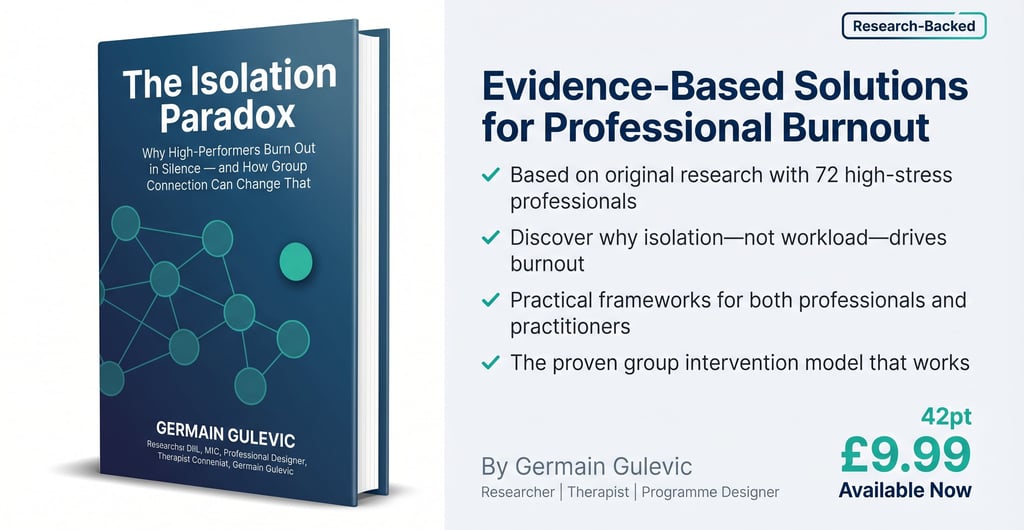
The Isolation Paradox.
Why High-Performers Burn Out in Silence — and How Group Connection
The hidden reality of high-performance roles
You manage teams.
You solve problems.
You keep things running when others can’t.
From the outside, you look in control. But internally?
You haven’t had a real conversation about how you’re actually doing
You’re constantly “on,” even when you’re exhausted
You carry decisions, pressure, and responsibility that don’t leave at 5pm
You feel alone in environments full of people
This isn’t burnout as it’s usually described.
This is something more precise — and more dangerous.
It’s professional isolation.
The insight most wellbeing programmes miss
Modern workplace wellbeing is built on the wrong assumption:
That stress is an individual problem, solved with individual tools.
Apps.
Breathing exercises.
One-off resilience workshops.
They all assume the same thing:
“If you cope better, you’ll feel better.”
But the research behind this book shows something different.
The professionals most at risk of burnout aren’t lacking coping skills.
They’re lacking genuine, psychologically safe connection.
Burnout is not always a personal failure.
Introducing the Isolation–Connection Paradox
Based on original research across 72 high-stress professionals and practising therapists, this book identifies a critical pattern:
The more socially active a professional role is…the more likely it is to produce isolation.
You’re expected to be composed
You’re responsible for others, but unsupported yourself
You can’t risk vulnerability without professional cost
What this book does differently
Why high performers burn out in silence
A deep dive into the structural drivers of stress across:
Healthcare
Education
Law & management
Public safety
A practical roadmap for action
Whether you are professional seeking support that fits your reality
Or a practitioner building services that people will actually use
Why most wellbeing solutions fail
And why apps, EAPs, and one-day workshops don’t reach the people who need them most
The three paradoxes reshaping workplace mental health
The Isolation–Connection Paradox
The Employer Support Paradox
The Willingness-to-Pay Paradox
What actually works (backed by evidence)
Small, structured peer groups
Multi-session formats (not one-off fixes)
Blended skills + real human connection
This is not another generic burnout guide. It is a research-driven blueprint for understanding — and solving — professional stress at its root. Inside, you’ll discover:
If you are a high-stress professional:
You feel the pressure, but can’t show it
You’ve outgrown generic advice
You want something that actually reflects your world
This book will help you understand:
Why you feel the way you do
What actually works
Where to find or build the right kind of support
If you are a practitioner, coach, or programme designer:
You’ve seen clients who don’t fit standard models
You know one-to-one work isn’t always enough
You want evidence-based, scalable group solutions
This book gives you:
A complete service design framework
Data on what professionals actually want
A model that is both clinically credible and commercially viable