Why Stress Management and Resilience Training Is Now a Business-Critical Investment
Discover why leading organisations invest in stress management and resilience training for their workforce. Evidence-based programmes that reduce burnout by 76% and deliver up to 800% ROI. Book a free consultation.
2/18/20265 min read


Workplace stress isn't a personal problem your employees need to solve on their own. It's an organisational risk — one that quietly erodes productivity, drives up absenteeism, and pushes your best people out the door.
A 2024 Deloitte study found that 77% of employees have experienced burnout at their current employer. Meanwhile, research consistently shows that companies embedding wellbeing into their culture see up to 20% higher productivity and significantly stronger retention.
The question for HR directors, people leaders, and senior executives is no longer "Should we invest in stress management?" — it's "How quickly can we implement something that actually works?"
The Real Cost of Ignoring Workforce Stress
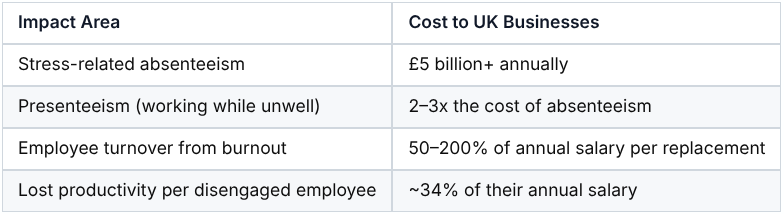
Most organisations underestimate the financial impact of unmanaged stress. The numbers tell a sobering story:
85% of employees say they would consider leaving a company that doesn't prioritise wellbeing. In today's talent market, a reactive approach to stress is a competitive liability.
What "Stress Management" Actually Means in 2026
The corporate wellness landscape has evolved dramatically. Token fruit bowls and annual yoga sessions no longer satisfy employee expectations — or deliver measurable results.
Modern, evidence-based stress management for the workforce involves:
Systemic intervention — identifying and reducing organisational stressors at their source, not just teaching individuals to "cope better"
CBT-informed techniques — Cognitive Behavioural Therapy approaches that give employees practical, science-backed tools for managing pressure, unhelpful thought patterns, and emotional regulation
Managerial capability building — equipping leaders to recognise early signs of burnout, hold psychologically safe conversations, and model healthy boundaries
Personalised support pathways — confidential 1:1 sessions for employees who need targeted help processing challenges
This is the approach we take: combine business psychology with evidence-based therapeutic training — including CBT and existential wellbeing counselling — to create practical interventions that fit your culture, not a generic template.
Why Resilience Training Fails (and How to Make It Work)
Let's be direct: most resilience training programmes fail because they place the burden entirely on the individual.
Telling an overworked employee to "build resilience" without addressing the system creating the overwork is, at best, ineffective — and at worst, damaging. It signals that the organisation views stress as a personal deficiency rather than a structural issue.
Effective resilience training works on two levels simultaneously:
1. Individual Resilience Skills
Employees gain practical techniques they can apply immediately:
Cognitive reframing — identifying and challenging stress-amplifying thought patterns
Energy management — protecting focus and preventing the slow drain that leads to burnout
Boundary setting — communicating limits without career anxiety
Recovery practices — understanding that rest isn't a reward for productivity; it's a prerequisite for it
2. Organisational Resilience Infrastructure
The organisation addresses the conditions that create chronic stress:
Workload audits — identifying where systemic overload exists
Psychological safety — creating environments where people can flag problems without fear
Policy alignment — ensuring that HR policies, performance frameworks, and management practices actively support wellbeing rather than undermine it
Early warning systems — using engagement data and manager check-ins to spot burnout before it becomes a resignation letter
Our Workshops & Team Sessions cover psychological safety, resilience, mindful productivity, and communication under pressure. But we don't stop at workshops. Our Wellbeing Strategy & Advisory service aligns your policies, training, and support pathways so that mental health becomes embedded in your culture — not bolted on as an afterthought.
The Business Case: What Does the ROI Actually Look Like?
Decision-makers need data, not just good intentions. Here's what the evidence shows:
Measurable Outcomes from Structured Wellbeing Programmes
Up to 800% ROI on workplace CBT therapy and psychological wellbeing services
76% reduction in employee burnout when organisations implement comprehensive mental health frameworks
Decreased absenteeism — employees with access to proactive mental health support take fewer unplanned days off
Improved retention — 86% of employees now consider wellbeing support as important as salary when evaluating an employer
Higher performance — 97% of CEOs report that wellness programmes improve productivity across their organisations
These aren't aspirational projections. They're outcomes that organisations achieve when they move from reactive Employee Assistance Programmes to proactive, integrated wellbeing strategies.
What a Practical Stress Management Programme Looks Like
If you're evaluating providers, here's what to look for — and what we deliver:
Leadership & Performance Coaching
Your managers and senior leaders set the tone for your entire organisation's relationship with stress. Our coaching helps them:
Navigate workplace pressure with clarity, not reactivity
Make better decisions under uncertainty
Establish and model healthy work boundaries
Sustain high performance without sacrificing their own wellbeing
Burnout Prevention Programmes
Rather than waiting for burnout to happen, we help you identify early warning signs across your teams, reduce systemic stressors in your workflows and culture, and implement simple, energy-preserving routines that protect focus and engagement.
Confidential 1:1 Employee Support
Some challenges need a private, safe space. We provide short-term, goal-focused sessions where employees can process workplace difficulties, personal pressures, or career transitions with a qualified professional — with complete confidentiality.
Wellbeing Strategy & Advisory
For organisations ready to make a lasting shift, we work with your leadership team to:
Audit current wellbeing provisions and identify gaps
Align policies and training to support mental health systemically
Design support pathways that employees actually use
Establish success metrics — attendance, feedback, and observable behavioural shifts
Who This Is For
Our corporate programmes are designed for:
HR Directors and People Leaders looking to reduce burnout, absenteeism, and turnover with evidence-based interventions
Senior Executives and C-Suite who understand that workforce wellbeing directly impacts business performance
Team Leaders and Managers who want practical tools for supporting their teams without becoming informal therapists
Organisations of any size — from scaling startups to established enterprises — in London or anywhere via online delivery
How to Get Started
We keep the entry point simple. Book a free 20-minute discovery call where we'll:
Clarify your goals — what does success look like for your organisation?
Understand your constraints — budget, timeline, team dynamics
Propose a light-touch plan — a realistic starting point, not an overwhelming overhaul
Agree on success metrics — so you can measure impact from day one
Delivery is flexible: online, in-person in London, or hybrid — whatever works for your teams.
Frequently Asked Questions
How is this different from an Employee Assistance Programme (EAP)?
EAPs are typically reactive — employees access them when they're already in crisis. Our approach is proactive and systemic. We work with your leadership and culture to prevent burnout, build resilience, and create an environment where stress is managed before it becomes a problem. We also provide confidential 1:1 support, but it's part of a wider strategy — not a standalone helpline.
Qualifications and background
Germain combines a background in business management (MBA) with CBT (Cognitive Behavioural Therapy) and existential wellbeing counselling, with ongoing professional development. This dual expertise in business psychology and therapeutic practice means our interventions are both commercially aware and clinically informed.
Can this work for remote or hybrid teams?
Absolutely. All our services — coaching, workshops, 1:1 support, and strategy advisory — are available online. We've designed our programmes to be effective regardless of where your people are based.
How quickly can we see results?
Most organisations notice shifts in team dynamics and engagement within the first 4–6 weeks of implementation. We establish measurable benchmarks from the outset so progress is tracked, not assumed.
What size of organisation do you work with?
We work with organisations of all sizes. Whether you're a 10-person startup experiencing rapid growth or a large enterprise looking to refresh your wellbeing strategy, we tailor our approach to fit your context.